Keyword Research
The best Amazon keyword clustering guide (with step-by-step TFSD mapping)
Amazon keyword clustering explained: group search terms by intent, map clusters to TFSD listing sections, and structure PPC campaigns around them.

Amazon keyword clustering is the process of grouping related search terms by shopper intent, then mapping each group to a specific section of your listing. If you’ve ever pulled 800 keywords from a reverse ASIN lookup for something like a magnetic phone mount, you know the problem. Half the terms duplicate each other, the high-converting long-tails get buried, and your title ends up a keyword salad that ranks for nothing.
Amazon’s search algorithm (as of early 2026) judges relevance at the cluster level, not the individual keyword level. A listing that ranks for “magnetic phone mount,” “car phone holder,” and “dashboard phone stand” together signals topical authority. Ranking for just “phone mount” in isolation does not.
This guide walks the full clustering workflow: pulling a keyword universe, scoring each term, grouping by intent, mapping clusters to TFSD listing sections, and structuring PPC around cluster logic. A magnetic phone mount runs as the example throughout so you can copy the pattern.
What is Amazon keyword clustering and why does it matter?
Amazon keyword clustering groups related search terms by shared shopper intent, then maps each group to a specific listing section. Clustering, grouping, and segmentation often get used interchangeably, but clustering is specifically about intent, not surface-level word overlap.
Amazon’s algorithm evaluates relevance at the cluster level. A listing ranking for “magnetic phone mount,” “car phone holder,” and “dashboard phone stand” all at once reads as topical authority. Ranking for just one head term doesn’t carry the same weight.
The typical failure mode is chasing 20 high-volume keywords and ignoring the 200 long-tail variants that actually complete the cluster. Coverage gaps stop Amazon from connecting your product to a specific intent, and competitors who capture those long-tails eventually take the head terms too.
Clustering replaces the stuff-everything-into-the-title approach with a real structure. Sellers who group terms into unified themes give Amazon the completeness signal it wants. For a broader view on how listing structure ties into search, see the Amazon listing optimization guide and the keyword research methodology.
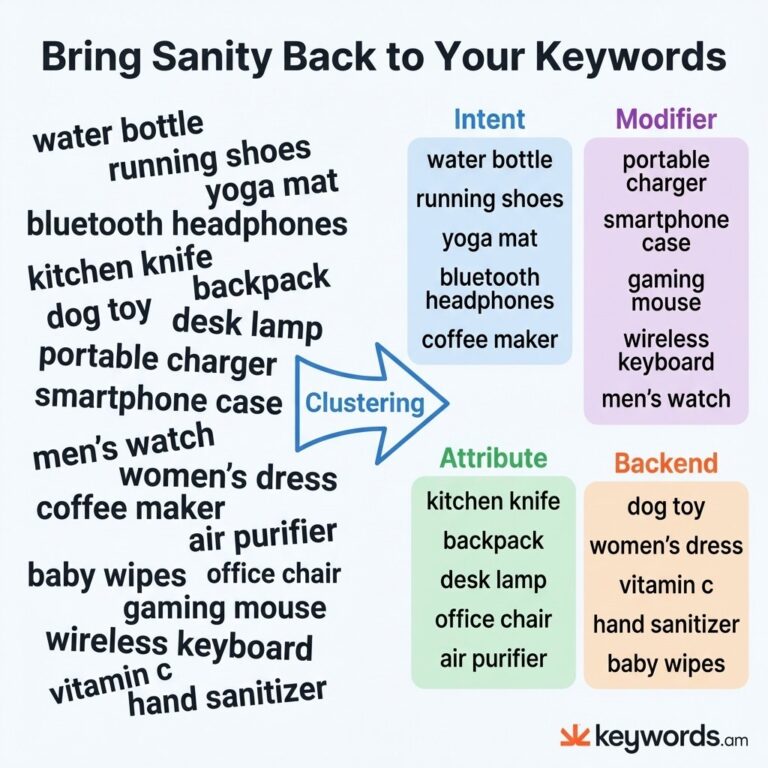
What are the 3 types of Amazon keyword clusters?
Amazon keyword clusters break down into three types: intent-based, attribute-based, and modifier-based. Each serves a different purpose, so mixing them in one bucket sends muddled signals to both the algorithm and your PPC data.
Intent-based clusters sort by purchase readiness. Using the phone mount example: “best phone mount for car 2026” is research intent, “magnetic vs clamp phone mount” is comparison intent, and “magnetic phone mount for car dashboard” is purchase intent. Each stage belongs in its own cluster because the listing section that answers it changes.
Attribute-based clusters organize by what the product is or does. Features, benefits, use cases, and target audiences all get their own groupings. A benefit cluster pulls “hands-free phone mount for driving,” while an audience cluster captures “phone mount for uber drivers.” These clusters do most of the work in your bullets and A+ Content.
Modifier-based clusters are the PPC workhorse. They organize around variants like size, color, or material. “Large phone mount,” “black phone mount for car,” and “metal magnetic phone mount” each carry different expectations, and giving them their own ad groups stops wasted spend on mismatched clicks.
| Cluster Type | Grouping Logic | Best For | Example |
|---|---|---|---|
| Intent-based | Purchase readiness | Listing sections (TFSD) | research / comparison / purchase |
| Attribute-based | Product features | Bullet points, A+ Content | feature / benefit / use case |
| Modifier-based | Specific variants | PPC ad groups | size / color / material |
The PPC keyword strategy breakdown shows how modifier clusters plug into ad groups, and the bullet points guide covers where attribute clusters land in copy.
How do you cluster Amazon keywords step by step?
The five-step process: pull the keyword universe via reverse ASIN, score with KPS, group by shopper intent, map to TFSD sections, and fill backend gaps. Most sellers skip from raw export straight to writing copy, which is where cannibalization starts.
Step 1: Pull your keyword universe. Grab 3 to 5 competitor ASINs for the magnetic phone mount and run a reverse ASIN lookup to build your base list. Expand it with long-tail variants until you have roughly 500 to 1,000 raw keywords. That’s enough to capture head terms plus the modifiers that complete each cluster.
Step 2: Score and prioritize with KPS. Sorting by search volume alone ignores relevance and conversion potential. KPS scoring rates each keyword from 0 to 100 based on how much it can move the listing. A term with 500 monthly searches at 85 KPS beats a generic 5,000-search term at 30 KPS.
Step 3: Group by shopper intent. Split your scored list into three buckets: problem-aware (“phone keeps falling while driving”), solution-aware (“best phone mount for car”), and product-aware (“magnetic phone mount for dashboard”). The product-aware bucket is where the money terms live.
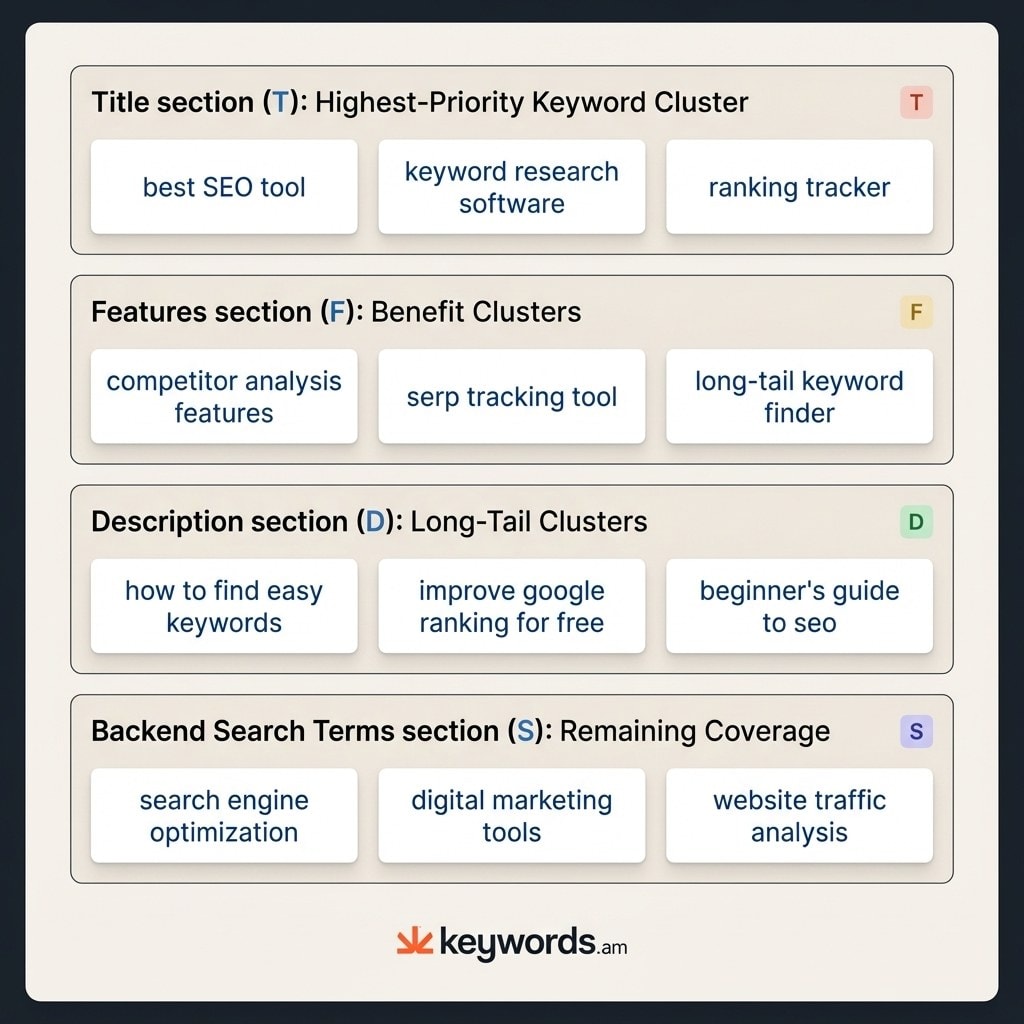
Step 4: Map clusters to listing sections via TFSD. The TFSD framework assigns each cluster a section. Title takes the highest-KPS product-aware cluster. Features and Bullets take supporting benefit clusters. Description and A+ Content pick up long-tail and contextual terms. Backend absorbs whatever coverage remains.
| TFSD Section | Cluster Priority | Cluster Type | Example Keywords |
|---|---|---|---|
| Title | Highest KPS, product-aware | Intent-based | magnetic phone mount for car |
| Features | Supporting benefits | Attribute-based | hands-free, easy install, strong magnet |
| Description | Long-tail, contextual | Attribute + Intent | phone mount for delivery drivers, uber phone holder |
| Backend | Remaining coverage | All (deduplicated) | dashboard mount, vent clip holder, car phone holder |
Step 5: Fill backend gaps. Backend search terms aren’t a dumping ground for title duplicates. Amazon caps backend at 249 bytes (as of 2025), so every byte should carry a term that isn’t already in the title, bullets, or description. Deduplicate the final list, then paste in only the unique remainder. The backend keywords guide covers the specifics.
How does keyword clustering improve Amazon PPC campaigns?
Amazon keyword clustering turns bloated PPC accounts into structured ad groups where each group targets one intent cluster. That makes bid optimization and negative keyword management far more precise.
When different intent clusters share an ad group, bids get set on blended data that doesn’t reflect any single shopper stage. A brand defense cluster (your branded terms) needs a different approach than a mid-funnel cluster targeting “best phone mount” comparisons, which needs a different approach than an upper-funnel cluster targeting “phone keeps falling in car.”
Roughly 25 to 60 keywords per cluster-based ad group tends to hit a workable balance. Under 25 and reach suffers; over 60 and relevance dilutes.
A simple three-bucket framework:
- Brand defense clusters get high bids on exact match
- Mid-funnel comparison clusters get moderate bids on phrase match
- Upper-funnel awareness clusters get low bids on broad match to catch discovery searches
Managing PPC campaign structure through clusters lets you adjust a whole group when it underperforms, instead of tweaking hundreds of individual bids. It also makes negative keywords easier to spot, since irrelevant search terms cluster together too.
What are the most common Amazon keyword clustering mistakes?
Four mistakes account for most clustering failures: grouping by volume instead of intent, stuffing every cluster into the title, ignoring backend fields, and never updating clusters after launch.
Grouping by volume instead of intent. “Phone mount” is generic and “magnetic phone mount for car dashboard” is specific. They shouldn’t share a cluster just because search volumes look similar. Intent defines the group.
Cramming every cluster into the title. The title gets one primary cluster. Squeezing three clusters into 200 characters wrecks readability and confuses relevance signals. Pick the highest-KPS group and commit. The product title optimization guide covers structure in detail.
Ignoring backend search terms. Backend fields exist for cluster overflow and long-tail variants. Leaving them empty or pasting title duplicates throws away 249 bytes of indexing potential.
Never revisiting clusters after launch. Clusters aren’t set-and-forget. Seasonal trends, competitor launches, and algorithm updates shift the landscape. A cluster driving 40% of traffic in Q1 can drop to 15% by Q3.
One more worth flagging: international sellers who translate clusters word-for-word. “Phone holder” in the US and “mobile phone stand” in the UK belong in the same intent bucket, but you won’t get there through translation alone. Build clusters per marketplace, or use competitor analysis to confirm the local vocabulary.
Frequently Asked Questions About Amazon Keyword Clustering
What is the best tool to cluster Amazon keywords?
Keywords.am’s TFSD framework is built specifically for Amazon clustering, with KPS scoring for prioritization and coverage indicators for gap detection. Generic SEO tools like Keyword Insights or SE Ranking cluster by Google SERP overlap, which doesn’t reflect how Amazon’s search algorithm groups intent. They also can’t map terms to listing sections like title, bullets, or backend.
How many keyword clusters should each Amazon listing have?
Most listings need 5 to 8 primary clusters for full coverage across title, bullets, description, and backend. Simple products like a phone mount usually sit at 5, while complex multi-function items can push toward 10. Depth matters more than count; five well-populated clusters beat ten thin ones.
Is keyword clustering different for PPC vs listing SEO?
Yes. SEO clusters map to TFSD sections for organic coverage, while PPC clusters map to ad groups for bid control and negative keyword isolation. The base clusters overlap, but PPC layers in modifier-based sub-clusters (size, color, material) that don’t always need to appear in listing copy.
How often should sellers update their keyword clusters?
Review clusters at least quarterly, and immediately after seasonal peaks, competitor launches, or algorithm shifts. Coverage indicators flag gaps in real time, so if a cluster’s coverage score drops below 60%, refresh it right away.
Can sellers use Google keyword clustering tools for Amazon?
Not reliably. Google clustering groups keywords by SERP similarity, which has nothing to do with Amazon’s purchase-behavior signals. A Google tool will lump “phone mount” and “phone mount reviews” together, but on Amazon those represent different intents and belong in different clusters. The Amazon SEO vs Google SEO breakdown covers why the two systems diverge.
Conclusion
Amazon keyword clustering bridges the gap between raw keyword research and listings that convert. It eliminates cannibalization, maximizes backend space, and structures PPC campaigns around real intent stages.
- Clustering builds semantic authority by grouping terms by buyer intent, not by chasing individual keywords
- TFSD mapping gives every cluster a home (title, bullets, description, backend)
- The same clusters that drive organic SEO also structure cleaner, more profitable PPC ad groups
- Google clustering tools don’t translate to Amazon because the ranking signals are fundamentally different
- Quarterly refresh cycles keep clusters aligned with seasonality and competitive shifts
Pull the keywords for your top ASIN, group them into 5 to 8 intent-based clusters, and map each one to a TFSD section. The free Amazon keyword tool will get you started, and if you want KPS scoring plus coverage indicators baked into the workflow, Keywords.am handles the full stack.