Keyword Research
How to Find the Best Amazon Long Tail Keywords (5 Methods Top Sellers Actually Use)
Find Amazon long tail keywords that convert 2-3x better than head terms. Five methods top sellers use to lower PPC costs and rank faster in 2026.

A single broad keyword like “phone mount” pulls 300,000+ monthly searches on Amazon. But the seller ranking first for that term likely earns more total sales from the 200+ Amazon long tail keywords surrounding it. Most sellers optimize for a handful of head terms and ignore the specific phrases that actually drive conversions. Long-tail queries make up roughly 70 to 80 percent of total search volume across e-commerce platforms (as of 2025).
What follows is a breakdown of what long-tail keywords mean on Amazon, why they outperform head terms, five ways to find them, and where to slot them across a listing. Most SEO advice gets recycled from Google playbooks and doesn’t account for how Amazon’s search engine actually works. This piece stays focused on purchase intent signals, indexing behavior, and PPC bid efficiency. To keep things concrete, picture a “magnetic phone mount for car” as the product, with long-tails like “magnetic phone mount for car vent MagSafe compatible” branching off it.
What are Amazon long tail keywords and how are they different from Google?
Amazon long tail keywords are specific multi-word search phrases with lower individual volume but higher purchase intent, usually four to eight words describing exactly what a shopper wants to buy.
Compare “phone mount” against “magnetic phone mount for car vent MagSafe compatible.” The first is a head term, short and generic. The second is a long-tail that paints a clear picture of the exact product the buyer wants.
The Amazon keyword research methodology highlights the gap between Google and Amazon search behavior. On Google, “best phone mount” often signals research. On Amazon, every search is a buying search, and the long-tail just narrows what the shopper wants to buy. That difference is the core of Amazon SEO vs Google SEO.
The volume story is just as interesting. The top 100 keywords in most categories account for roughly 20 percent of total search traffic. The other 80 percent lives in thousands of long-tail variations, and that’s where the conversions hide.
| Factor | Head Term (“phone mount”) | Long-Tail (“magnetic phone mount for car vent MagSafe”) |
|---|---|---|
| Monthly searches | 300,000+ | 2,000-8,000 |
| Competition | Extreme (500+ sellers) | Moderate (50-100 sellers) |
| Conversion rate | 8-12% | 18-25% |
| PPC cost per click | $1.50-3.00 | $0.40-0.80 |
| Buyer intent | Browsing | Ready to purchase |
Representative data comparing head terms and long-tail keywords on Amazon (as of early 2026).
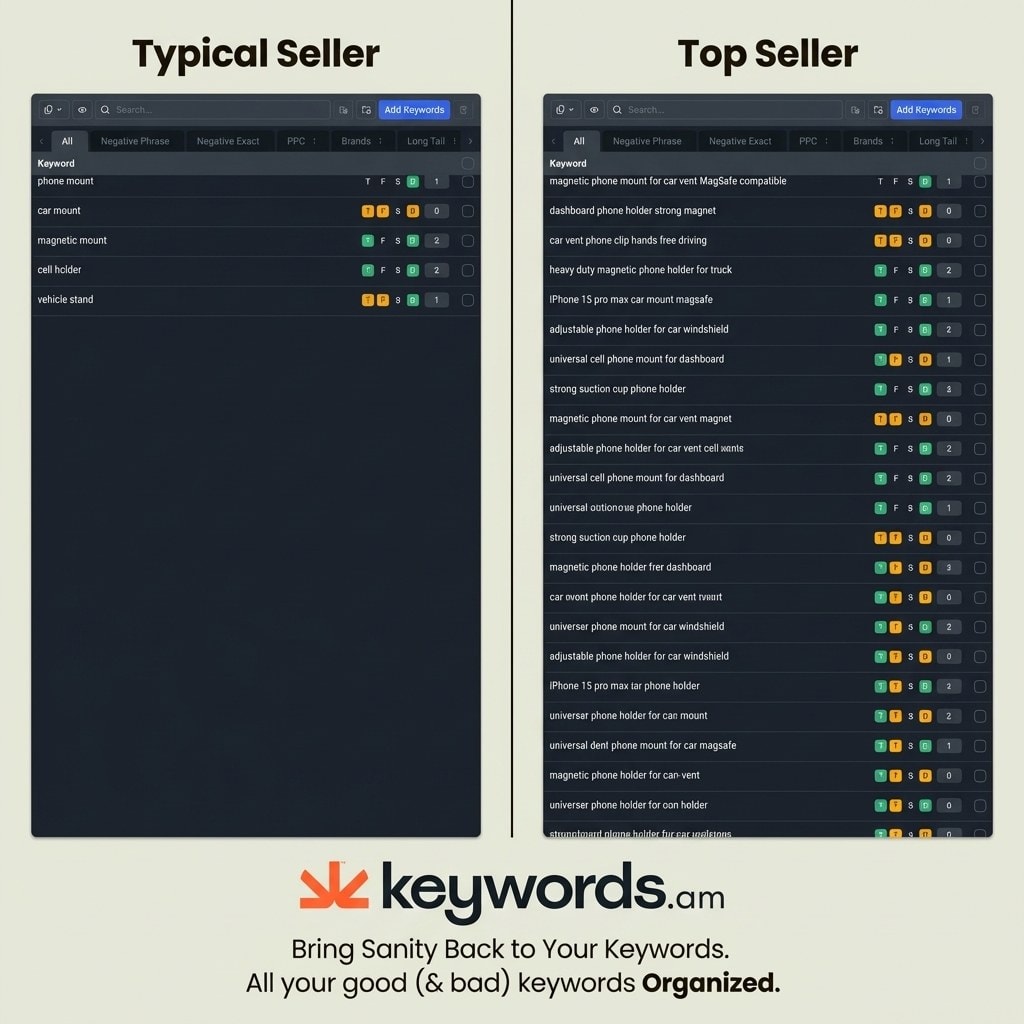
Understanding what long-tails are raises the obvious follow-up: just how much better do they perform?
Why do long-tail keywords convert 2-3x better on Amazon?
Long-tails convert two to three times higher because every Amazon search carries purchase intent, and longer phrases come from shoppers who already know what they want.
The numbers back it up. Long-tails typically convert at 18 to 25 percent while head terms sit around 8 to 12 percent. When someone types six or more words into the Amazon search bar, they’ve already decided what they need and are comparing options rather than browsing.
There’s a PPC angle too. Bidding on “phone mount” can cost $2 or more per click. Switch to “magnetic phone mount for car vent” and that drops to somewhere between $0.50 and $0.80, with a better conversion rate on top. That’s roughly 50 to 70 percent less spend per click based on typical PPC benchmarks (as of early 2026).
Competition matters as well. A brand-new listing can break into page one for a specific long-tail phrase in a few weeks. Try that for a head term and it’ll take months of stacking reviews and sales velocity before anything moves.
One detail many sellers miss: Amazon’s search algorithm matches queries to the phrases inside a listing. Pack more relevant long-tails into the listing and there are more potential matches for buyer searches. It’s worth verifying whether Amazon actually indexed those terms, because gaps go unnoticed otherwise.
How do you find Amazon long tail keywords (five proven methods)?
The five most reliable methods are autocomplete mining, PPC Search Term Reports, reverse ASIN lookups, Brand Analytics, and AI-powered keyword generation.
Method 1: Amazon autocomplete mining. Open Amazon, type a seed keyword, and pay attention to the suggestions. The trick is to type “magnetic phone mount” and then add the letter “a,” note the suggestions, then “b,” then “c.” Each letter pulls a different set of long-tail phrases that real shoppers search for. It takes 30 to 60 minutes per seed keyword, which adds up across a catalog.
Method 2: Search Term Reports from PPC campaigns. Anyone running ads has a gold mine in Seller Central. Pull up Advertising, then Reports, and download the Search Term Report. It shows the exact queries shoppers typed before clicking, with real conversion data attached. The catch is that it only exists if PPC campaigns are running.
Method 3: Reverse ASIN lookup on competitors. Pull the keywords a competitor ranks for, filter for phrases of four or more words, and the long-tails surface fast. Checking the top three competitors typically reveals 200 to 500 variations. The reverse ASIN lookup guide walks through the full workflow, and competitor analysis puts the data in context.
Method 4: Brand Analytics Search Query Performance. Sellers enrolled in Amazon Brand Registry get access to first-party search data through Brand Analytics. The upside is real search frequency rank and click share percentages rather than third-party estimates. Sorting by search frequency rank surfaces long-tails with verified demand.
Method 5: AI-powered long-tail generation. AI tools can take a single seed keyword and generate dozens of brand-free shopper phrases, the kind of specific, attribute-rich queries real buyers type. Keywords.am’s IntentIQ generates these variations in seconds without including competitor brand names. The output focuses on product attributes and use cases, available through the free Amazon keyword tool.
Finding long-tails is half the battle. The next step is deciding which ones are actually worth targeting.
How do you evaluate which long-tail keywords to target?
Evaluate long-tails on three criteria, relevance, verified demand, and competition, then score them to prioritize the highest-impact terms.
Relevance comes first. “Magnetic phone mount for car vent MagSafe compatible” is only worth targeting if the product genuinely supports MagSafe. Irrelevant long-tails waste indexing space and tank conversion rates.
Verified demand matters next. Some long-tails look great on paper but have effectively zero Amazon search volume. Use Brand Analytics search frequency rank or keyword tools to confirm demand exists before committing space to a phrase.
Competition closes out the trio. Check how many strong listings already rank for the term. A long-tail dominated by five listings with thousands of reviews each isn’t the easy win it looks like.
One filter trips up a lot of sellers: intent match. If somebody types “phone mount for truck dashboard heavy duty” but the product is a lightweight clip-on, that keyword isn’t worth chasing. Decent volume doesn’t matter if the listing fails to deliver on what the search promised, because the conversion rate will collapse.
Once the list is prioritized, the next step is placing keywords across listing fields strategically.
Where should you place long-tail keywords in your listing?
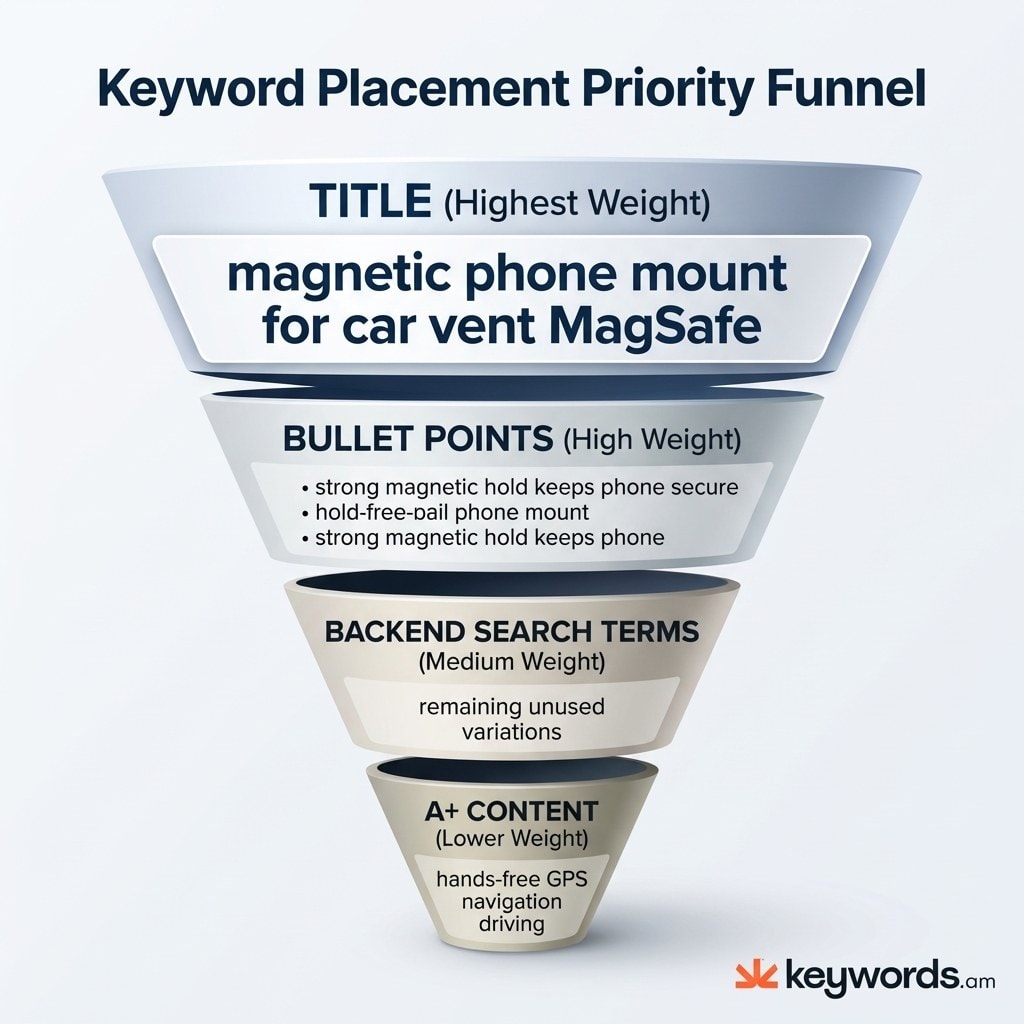
Place the highest-priority long-tails in the title, secondary ones in bullets, and remaining variations in backend search terms where they index without cluttering visible copy.
Title keywords carry the most ranking weight, so the top one or two long-tails belong there. Front-load the primary phrase. Example: “Magnetic Phone Mount for Car Vent, MagSafe Compatible, Strong Hold, Dashboard and Windshield.” The product title optimization guide covers the formatting rules.
Bullet points are the next tier. Work three to five long-tail variations in, but keep each bullet describing a real feature or benefit. If it reads like a keyword dump instead of product copy, the listing won’t convert even if it ranks. The bullet points guide breaks down structure in detail.
Backend search terms catch what didn’t fit elsewhere. Amazon allows 249 bytes (as of 2025) and don’t repeat keywords already in the title or bullets. Amazon indexes across all three fields together, so duplication wastes space. The backend keywords guide spells out the byte rules and what Amazon ignores.
A+ Content shouldn’t be skipped either. Amazon now indexes A+ text modules in many categories, which adds real estate for long-tail variations. Module headers and body text both count.
| Listing Field | Ranking Weight | Long-Tail Priority | Example |
|---|---|---|---|
| Title | Highest | Top 1-2 primary long-tails | ”Magnetic Phone Mount for Car Vent MagSafe Compatible” |
| Bullet Points | High | 3-5 secondary long-tails | ”strong magnetic hold keeps phone secure on bumpy roads” |
| Backend Search Terms | Medium | Remaining unused keywords | Variations not already in title or bullets |
| A+ Content | Lower | Semantic long-tail variations | ”designed for hands-free GPS navigation while driving” |
| Product Description | Lower | Supporting long-tails | Feature copy with natural keyword integration |
One way to avoid guessing is the TFSD Framework, which shows coverage across title, features, search terms, and description so sellers can spot gaps before publishing. Combined with listing optimization fundamentals, it keeps the whole listing aligned.
How do long-tail keywords lower Amazon PPC costs?
Long-tails cut PPC costs by reducing cost-per-click through lower competition and lifting conversion rates through stronger intent match, dropping ACOS by 30 to 50 percent versus head terms.
One approach that works well is single keyword ad groups built around one exact-match long-tail each. The ad only fires for that specific phrase, and every click coming through has a high chance of converting. The PPC campaign structure guide covers how to organize this at scale.
Here’s the contrast. Run broad match on “phone mount” and the campaign starts showing ads for “phone mount for motorcycle,” which is useless if the product is a car vent mount. Run exact match on “magnetic phone mount for car vent” and the ad only triggers on that query.
Run the math on a $25 product. A head term at $2.00 per click with a 10 percent conversion rate produces an 80 percent ACOS, meaning most revenue goes back to Amazon. A long-tail at $0.60 per click with a 22 percent conversion rate puts ACOS around 11 percent. That gap is where profit lives, and it shows up in TACOS over time.
Negative keywords round out the strategy. Block irrelevant broad match traffic while exact match long-tails handle the targeted clicks. The PPC optimization guide ties the pieces together.
How do you track long-tail keyword performance?
Track long-tail performance by monitoring organic rank weekly, cross-referencing PPC search term reports monthly, and using Brand Analytics impression share to catch keyword decay early.
Most sellers invest hours identifying long-tails and never verify whether those terms are still driving results. That’s a real blind spot. Amazon’s algorithm is dynamic, and a long-tail that ranked on page one three months ago can slip to page three without any notification.
Step 1: Set a baseline. Right after updating a listing, record organic position for the top 10 to 15 target terms. Search each phrase from a private browser window to avoid personalization, or pull click share and purchase share from Brand Analytics Search Query Performance. This snapshot is the reference for everything that follows.
Step 2: Monitor SQP impression share monthly. Brand Analytics shows how impression share trends on specific queries. A declining share is an early warning that competitors are gaining ground, often before revenue drops. If a product held 14 percent impression share on a core long-tail and that drops to 8 percent over 30 days, organic position is almost certainly slipping.
Step 3: Use PPC search term reports as proxies. For sellers without dedicated rank tracking, PPC data gives a reliable indirect signal. When an exact-match long-tail campaign suddenly needs higher bids to hold the same placement, competitors have likely improved relevance for that term. Confirm with a manual rank check.
Step 4: Run quarterly indexing verification. Backend search terms can silently lose indexing after listing edits or algorithm changes. Verifying that long-tail keywords are still indexed is a quarterly audit, not a one-time task. If conversion rate starts dipping alongside rank drops, that’s the moment to dig in.
Frequently Asked Questions About Amazon Long Tail Keywords
How do long-tail keywords affect Amazon BSR?
Long-tails improve BSR indirectly by lifting conversion rates, which drive more sales velocity. Higher conversion signals strong product-market fit to Amazon’s algorithm, which then ranks the listing higher for those terms and expands exposure across related queries. BSR reflects total sales rank, so more high-intent conversions push it lower (better).
What’s the difference between long-tail keywords and misspellings?
Long-tails are specific multi-word phrases describing product attributes, while misspellings are typos Amazon usually autocorrects. Targeting common misspellings has diminishing returns because Amazon resolves them before the search runs. Long-tails describe genuine product variations and use cases that autocorrect can’t substitute for.
Should I target long-tails with very low search volume?
Yes, if they match purchase intent. A long-tail with 200 monthly searches and a 25 percent conversion rate often outperforms a head term with 50,000 searches and a 5 percent rate. Volume alone isn’t the metric, intent-weighted volume is what matters for conversion rate.
Can I use the same long-tails across multiple listings?
Only if the products genuinely match the phrase. Reusing long-tails across unrelated listings causes Amazon to split ranking signals between them, weakening both. For variations of the same product (color, size), shared long-tails are fine because Amazon treats them as one parent listing.
How often should I refresh my long-tail keyword list?
Quarterly is the typical cadence. New phrases enter the search graph as products and trends shift, and old ones lose relevance. Run a fresh autocomplete sweep and pull updated Brand Analytics data every three months to keep the list current.
Conclusion
- Long-tails convert two to three times better because every Amazon search carries purchase intent.
- Five methods exist to find them, and combining autocomplete mining with AI generation covers the most ground fastest.
- Placement order matters: title first, then bullets, then backend, then A+ content.
- Exact match PPC campaigns on long-tails drop ACOS to levels broad match can’t touch.
- Track organic position, SQP impression share, and PPC bid pressure to catch decay before revenue drops.
Open the Amazon search bar, type your main product keyword, and write down every autocomplete suggestion. That 10-minute exercise will surface 20 to 30 long-tails to start with.
For sellers who want to skip the manual work, Keywords.am’s IntentIQ generates hundreds of brand-free long-tail variations automatically. Try the free Amazon keyword tool or upgrade to a yearly plan to scale long-tail coverage across an entire catalog.