Amazon Fundamentals
What is Amazon FBA? The complete guide (and why most sellers fail without keyword research)
Learn what is Amazon FBA, how the fulfillment cycle works, current fee ranges, pros and cons, and why keyword research decides FBA profitability.

Over 60% of Amazon’s physical product sales come from third-party sellers, and most of those sellers use Fulfillment by Amazon (FBA) to handle shipping and customer service. Thousands of new merchants join the platform every month, and a large share of them quit within a year because they misread what the program actually rewards.
Most guides that answer what is Amazon FBA focus on shipping mechanics and skip the factor that decides whether FBA makes money: listing quality and keyword strategy. This guide covers how FBA works, what it costs as of early 2026, when it fits your product, and the overlooked connection between keyword research and FBA profitability that competitors ignore.
What is Amazon FBA and how does the fulfillment cycle work?
Amazon FBA (Fulfillment by Amazon) is a service where sellers ship inventory to Amazon warehouses, and Amazon handles storage, picking, packing, shipping, and returns.
Sellers send products to Amazon fulfillment centers, and Amazon takes over from receiving to delivery. This lets small businesses use Amazon’s logistics network without renting a warehouse or hiring shipping staff. The tradeoff is fees and a loss of packaging control.
The fulfillment cycle has five steps:
- Ship to Amazon: The seller preps and ships inventory into an Amazon warehouse.
- Storage: Amazon receives the inventory and distributes it across fulfillment centers.
- Order placement: A customer buys the item on Amazon.
- Pick, pack, ship: Amazon locates, packs, and ships the unit.
- Post-sale support: Amazon handles tracking questions, returns, and refunds.
The biggest structural advantage is automatic Prime eligibility. That badge signals fast free shipping to more than 200 million Prime members worldwide and helps win the Buy Box, where the vast majority of Amazon sales happen.
How much does Amazon FBA cost as of early 2026?
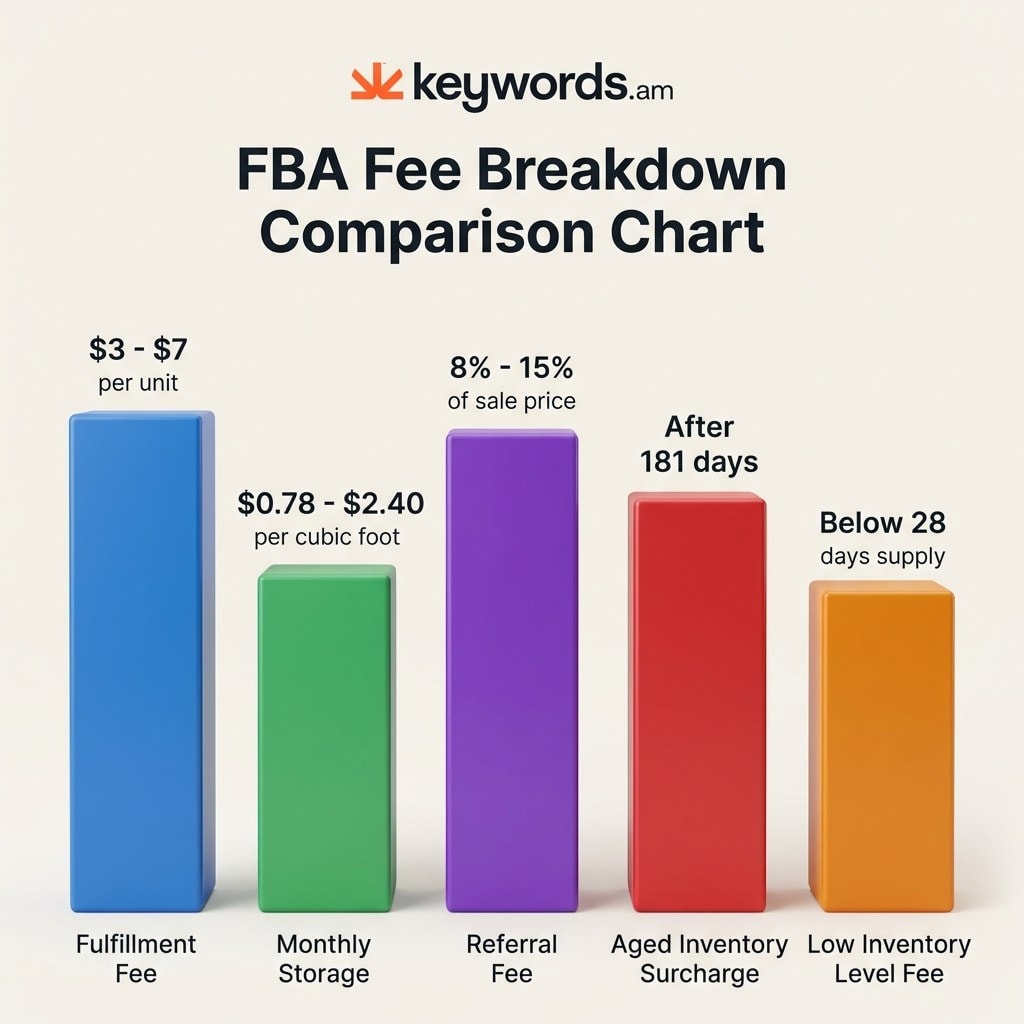
Amazon FBA costs stack up across per-unit fulfillment fees, monthly storage, category referral fees of 8-15%, and surcharges for aged or thinly-stocked inventory.
Understanding what is Amazon FBA from a cost angle is essential before sourcing a product. Amazon has continued adjusting fees each year to encourage faster inventory turnover and tighter packaging, so numbers below should be treated as approximate ranges (as of early 2026) and always double-checked in Seller Central for your exact SKU.
- Fulfillment fees: Charged per unit based on size and weight. Small standard items typically start around $3.00-$3.70. Large standard items in the 1-3 lb range fall roughly between $5.00 and $6.50. Oversized items climb much higher.
- Monthly storage fees: Roughly $0.78 per cubic foot from January through September for standard-size items, rising to about $2.40 per cubic foot during Q4 (October-December). Oversized rates are lower per cubic foot but based on much larger volumes.
- Referral fees: Amazon’s commission on each sale, usually 15% for most categories and around 8% for select categories like consumer electronics.
- Aged inventory surcharge: Extra fees on inventory held past 181 days, with steeper penalties at 271-365 days and again past 365 days. The point is to push slow SKUs out of the network.
- Low-inventory-level fee: Applies when a SKU’s historical days of supply drop below a threshold (about 28 days), penalizing stockouts as well as overstock.
FBA fee types at a glance (approximate, as of early 2026)
| Fee type | Approx. amount | When it applies |
|---|---|---|
| Fulfillment (small standard) | ~$3.00-$3.70/unit | Every unit sold |
| Fulfillment (large standard, 1-3 lb) | ~$5.00-$6.50/unit | Every unit sold |
| Monthly storage (Jan-Sep, standard) | ~$0.78/cubic foot | All inventory in FBA |
| Monthly storage (Oct-Dec, standard) | ~$2.40/cubic foot | All inventory in FBA |
| Referral fee | 8-15% of sale price | Every unit sold |
| Aged inventory (181-365 days) | Tiered per cubic foot | Slow-selling SKUs |
| Aged inventory (12+ months) | Higher per-unit or per-ft3 | Very slow SKUs |
| Low-inventory-level fee | Varies | Stock below ~28 days supply |
What are the pros and cons of using Amazon FBA?
FBA’s upside is Prime eligibility, Buy Box preference, and hands-off logistics. Its downside is higher per-unit cost, less packaging control, commingling risk, and Q4 storage spikes.
Deciding between FBA and self-fulfillment is a tradeoff between operational ease and cost control. For most scalable brands, FBA still wins on net, but the risks are real.
Pros to weigh:
- Prime badge on every eligible listing, which lifts click-through and conversion.
- Shipping rates that are often well below what a small seller could negotiate alone.
- Strong Buy Box preference in Amazon’s algorithm.
- Hours freed from packing and support, redirected into product and marketing work.
Cons to weigh:
- Higher total fees on cheap, light products with thin margins.
- Little control over unboxing (no custom-branded boxes, limited inserts).
- Commingling risk if you opt into stickerless inventory, since units can mix with other sellers’ identical products.
- Q4 storage spikes and aged-inventory surcharges that punish slow sell-through.
Many experienced sellers run a hybrid model. FBA carries high-velocity best-sellers, while FBM (Fulfilled by Merchant) handles oversized, fragile, or slow-moving SKUs where the per-unit FBA math doesn’t work.
When does FBA make sense (and when does it not)?
FBA fits small, lightweight products with healthy margins and steady demand. It struggles with oversized, ultra-cheap, or highly seasonal items that sit in a warehouse too long.
Fulfillment economics are dictated by dimensions and weight, so what works for a phone case fails for a kayak. Before sourcing, run the numbers on a specific SKU rather than trusting general rules.
The sweet spot looks like:
- Weight under about 3 lb and compact dimensions.
- Retail price between roughly $15 and $70.
- Margins above 30% after landed cost, all FBA fees, and expected returns.
- Year-round demand rather than a 6-week seasonal spike.
Poor fits for FBA include:
- Oversized or heavy items where fulfillment alone exceeds $10 per unit.
- Sub-$10 products where minimum fee floors eat any margin.
- Highly seasonal SKUs that risk long-term storage penalties.
- Fragile goods that need custom packaging FBA can’t provide.
A simple margin check: Sale Price - (Product Cost + Fulfillment Fee + Referral Fee + Storage Allocation + Inbound Shipping + Returns Reserve) = Profit. New sellers routinely miss 15-25% of true cost by ignoring returns and storage allocations. Before you send a unit anywhere, validate demand and volume so the fees are actually justified.
Why does keyword research determine FBA profitability?
Keyword research decides FBA profitability because better-targeted listings convert higher, need less PPC spend, and turn inventory faster, which shrinks storage and aged-inventory fees.
FBA profitability isn’t just a logistics calculation, it’s a velocity calculation. The fees that quietly kill FBA businesses (monthly storage, aged-inventory surcharges, low-inventory-level fees) are all penalties tied to how fast, or slow, you sell. The only way to avoid them is to sell inventory quickly, and the biggest lever on Amazon sales velocity is search visibility.
When a listing targets the right keywords, it shows up in front of shoppers who actually want that product. That relevance lifts click-through rates and, more importantly, conversion rates. A listing converting at 15% moves inventory almost twice as fast as one at 8%, which can be the difference between a 30-day turn (profitable) and a 90-day turn (paying storage penalties). See Amazon conversion rate for benchmarks by category.
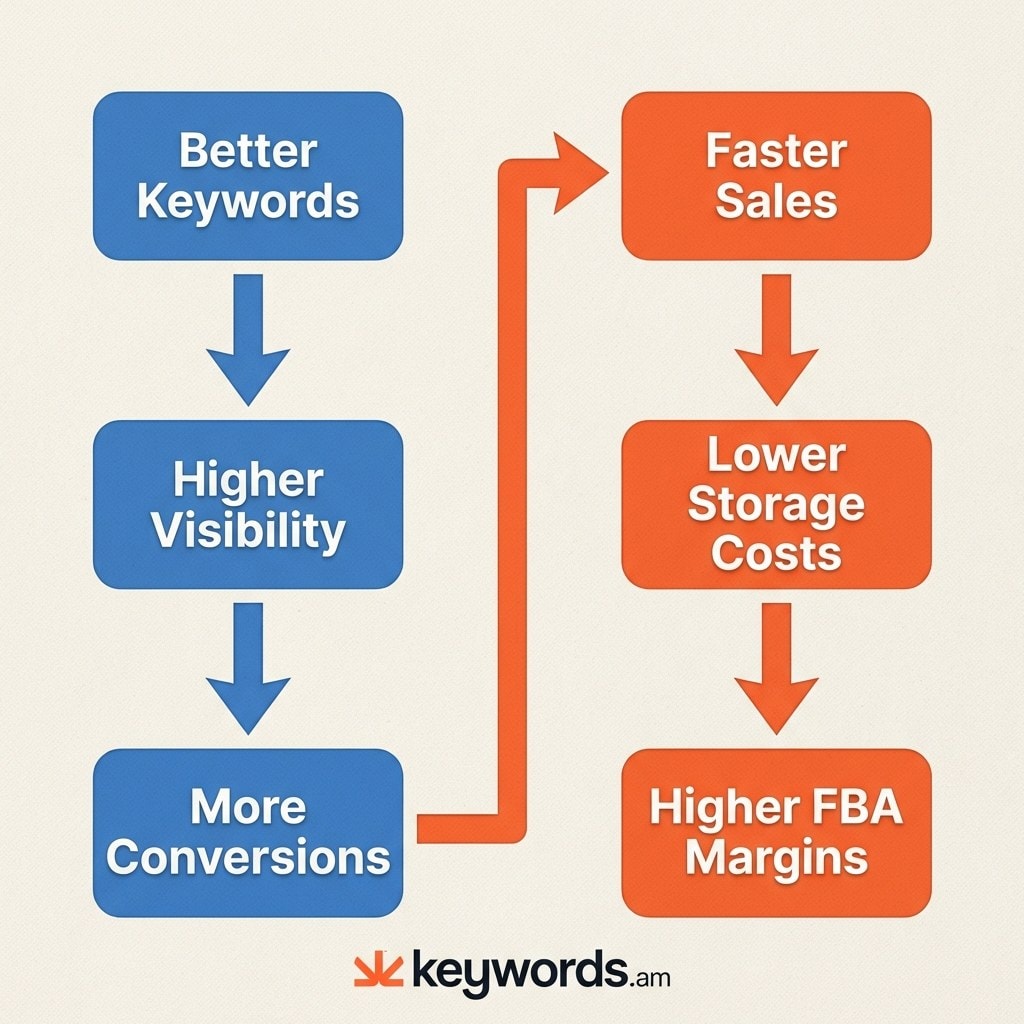
Advertising efficiency compounds the same effect. Listings with keyword-optimized titles and bullet points earn higher relevance scores, which lowers cost per click and ACoS. Weak keyword coverage means paying more to acquire every customer, eroding the margin FBA was supposed to protect. For the mechanics of PPC targeting once your keywords are set, see Amazon PPC optimization.
Practical optimization touches every part of the listing:
- Title, bullets, and description packed with high-intent search terms (product title optimization, bullet points guide).
- Backend keywords for indexing on terms that don’t fit visible copy.
- Reverse ASIN lookup to map how competitors are ranking.
- A methodical approach to research and prioritization, covered in the Amazon keyword research methodology.
Successful FBA products are effectively “born” in the research phase. Validating search volume and studying competitor listings before you buy inventory is how you avoid shipping 500 units into FBA for a keyword nobody searches.
How do sellers get started with Amazon FBA?
Getting started with Amazon FBA takes a Professional seller account, careful product research, an optimized listing, and a first inbound shipment that follows Amazon’s prep and labeling rules.
The launch process has become more standardized, but Amazon’s requirements for precision keep tightening.
- Create a Professional seller account at sellercentral.amazon.com. The Professional plan runs $39.99 per month and is required for the Buy Box and the reports you’ll actually need.
- Research and source a product. Use keyword demand data and competitor analysis to validate that shoppers are searching for what you plan to sell. Guessing is the most common way FBA money is lost.
- Draft an optimized listing. Write keyword-rich titles, bullets, and descriptions before inventory arrives. This is where FBA profitability is built or broken. If you’re brand-registered, plan out A+ Content too.
- Prep and ship inventory. Build a shipping plan in Seller Central, follow FNSKU labeling, poly-bagging, and box content rules, and confirm units are ready before they leave your hands. Amazon has continued to trim optional prep services in recent years, so shifting more work back onto sellers.
- Launch and iterate. Once inventory checks in, launch PPC campaigns targeting the keywords you validated in step 2 (campaign structure, negative keywords). Monitor search term reports weekly, prune waste, and refine copy to lift conversion. Keep an eye on both ACoS and TACoS to see the full profitability picture.
If you plan to build a defensible catalog long-term, register your trademark and enroll in Brand Registry as soon as it’s practical.
Frequently Asked Questions About Amazon FBA
Is Amazon FBA still worth it in 2026?
For lightweight products with margins above 30% and steady demand, FBA remains one of the most efficient ways to scale on Amazon. Fee increases have been modest since 2024, and Prime eligibility continues to drive higher conversion rates than self-fulfillment. The answer depends on your specific product economics, not on FBA as a general concept.
How much money do you need to start Amazon FBA?
Most new FBA sellers invest roughly $2,000 to $5,000 to cover initial inventory, the Professional account fee, product photography, and research tools. Starting lean with a single small product is possible for under $2,000, but very thin budgets leave no room for PPC or restocks. Plan for at least 3 months of runway before your first inventory turn.
What is the difference between FBA and FBM on Amazon?
FBA means Amazon stores your inventory and ships every order, while FBM (Fulfilled by Merchant) means you handle storage, packing, and shipping yourself. FBA listings almost always earn Prime eligibility and win the Buy Box more often, but they pay higher per-unit fees. Many sellers run a hybrid model, using FBA for best-sellers and FBM for oversized or slow-moving SKUs.
Do FBA sellers still handle customer service?
Amazon handles shipping questions, returns, and refunds for FBA orders, so most day-to-day support is off your plate. Sellers still answer product-specific questions through Buyer-Seller Messaging and are responsible for listing accuracy and product quality claims. Persistent quality issues can also trigger account health penalties, so FBA doesn’t eliminate customer responsibility entirely.
Can you use Amazon FBA without a registered brand?
Yes, sellers can use FBA through retail arbitrage, wholesale, or generic private-label products without Brand Registry. Registering a brand (which requires a trademark) unlocks A+ Content, Brand Analytics, and stronger listing hijacker protection. Many sellers launch without a registered brand and add it later once revenue justifies the trademark cost.
Conclusion
Amazon FBA handles the logistics so sellers can focus on the two things that actually decide profitability: product selection and listing optimization.
The mechanics of storage and shipping are detailed, but the formula for success is simple: precise keyword research feeds high-converting listings, and high-converting listings drive the sales velocity that keeps FBA math profitable.
- FBA is a fulfillment tool, not a business strategy on its own.
- Profitability tracks how fast you turn inventory, not how big your catalog is.
- Keyword research is the foundation of that velocity, cutting both storage costs and ad waste.
- Fee changes will keep happening, so keep validating your numbers per SKU.
Now that the question of what is Amazon FBA is settled, the next move is clear. Don’t rush units into a warehouse before you’ve validated the market. Start with real keyword data using the free Amazon keyword tool, or go deeper with a full plan by signing up here to build FBA decisions on evidence instead of guesses.