Keyword Research
How to research Amazon keywords for international marketplaces (the 5-step method that actually works)
Amazon international keyword research fails when sellers translate US keywords. This 5-step method finds marketplace-native keywords across 21 Amazon regions.

Amazon operates 21 marketplaces across four continents. Most sellers research keywords for a single market and run the rest through Google Translate. That approach leaves revenue on the table in every non-English region.
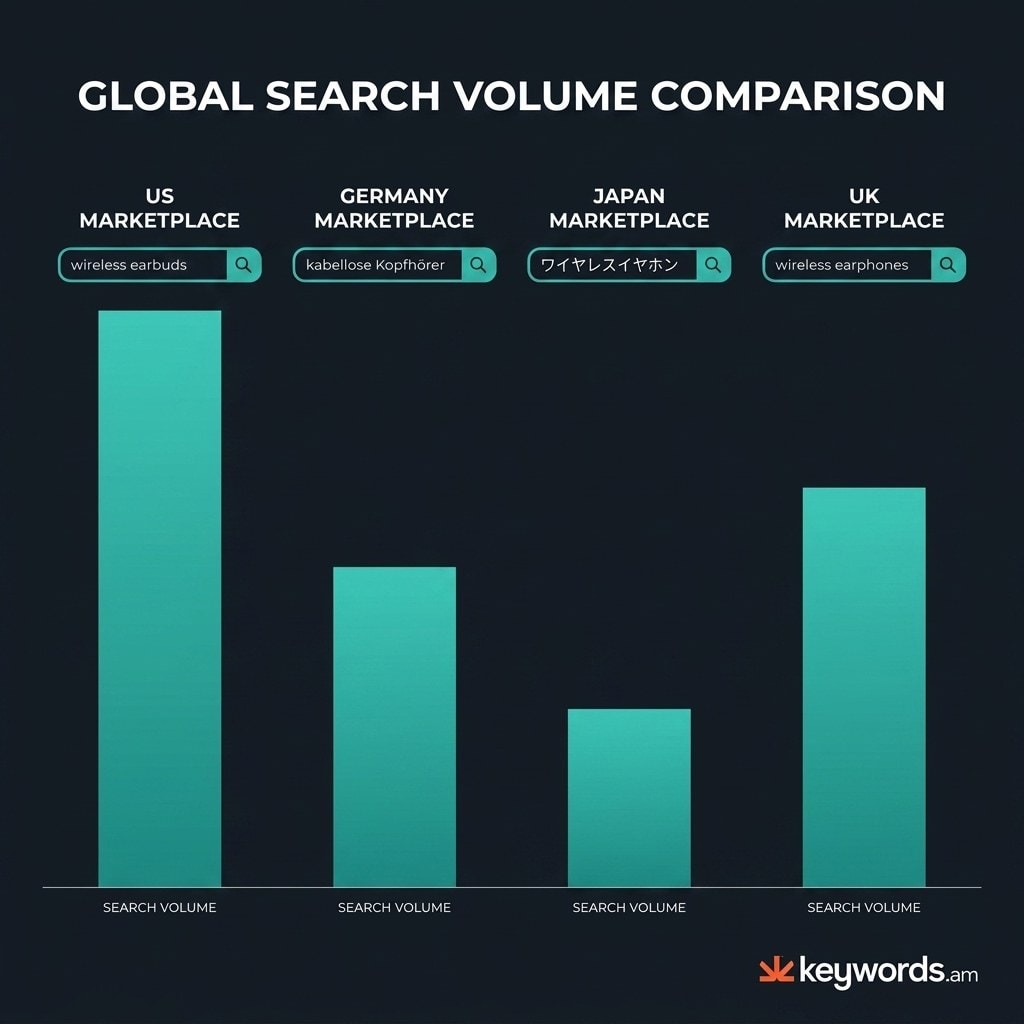
Translation-based amazon international keyword research fails because search behavior is culturally, linguistically, and structurally distinct across global Amazon operations. German shoppers search “kabellose Kopfhörer” (wireless headphones). They do not use the literal translation “drahtlose Ohrstöpsel” (wireless ear plugs). Launching a product using the direct translation means targeting zero search volume. It guarantees failure before the first unit ships.
Sellers need a structured, marketplace-native keyword research methodology. Relying on machine translation is guessing. Guessing destroys profit margins. This article outlines a five-step amazon international keyword research process that works across any Amazon marketplace. Concrete examples from Germany, Japan, the UK, and Mexico demonstrate how to adapt keyword strategy for local success and avoid costly international expansion errors.
Why does translating US Amazon keywords fail internationally?
Translating US Amazon keywords fails because shoppers in each marketplace use culturally specific search terms, compound words, and local idioms that machine translation cannot predict.
German compound words present a massive hurdle for direct translation. “Edelstahltrinkflasche” (stainless steel water bottle) functions as one word in German search behavior. Machine translation tools often output “Edelstahl Trinkflasche” as two separate words. That split creates a completely different search query with distinct ranking metrics. Amazon’s A9 algorithm treats the single compound word and the separated words as distinct entities. Sellers relying on the translated version will miss the primary search volume entirely. This Amazon listing translation error instantly kills organic visibility.
Japanese character sets complicate keyword strategy further. Amazon.co.jp shoppers search using kanji, katakana, and hiragana interchangeably. A single product might generate massive search volume across all three scripts. “ワイヤレスイヤホン” is the katakana for wireless earphones. “無線イヤホン” combines kanji and katakana. Both target different shopper intents and require separate tracking. Sellers cannot translate English into one Japanese variant and expect full market coverage. Ignoring script variations means handing sales directly to local competitors.
British and American English use entirely different vocabulary for common products. UK shoppers search for a “nappy” instead of a “diaper.” They buy a “dummy” rather than a “pacifier.” They wear “trainers” rather than “sneakers.” Translating the language is unnecessary, but replacing the keywords is mandatory. A US brand running ads for “diapers” on Amazon.co.uk will burn budget on irrelevant impressions while missing the actual buyer intent entirely.
Regional Spanish variations dictate search behavior across different countries. Shoppers in Mexico search for a “computadora,” while those in Spain search for an “ordenador.” Marketplace maturity also affects keyword difficulty. Amazon.com.mx currently has less competition than mature markets. The baseline metrics required for a successful product launch differ significantly based on these regional language nuances.
What are the 5 steps of international Amazon keyword research?
The five steps are: identify target marketplace categories, source marketplace-native seed keywords, expand with local search volume data, validate cultural intent, and map keywords to TFSD fields per marketplace.
Step 1: Identify target marketplace top categories
Product demand varies significantly by region. Electronics dominate sales volume on Amazon.de. Beauty products lead the way on Amazon.co.jp. Health supplements face entirely different regulatory environments across Europe, as outlined by Amazon’s Global Selling guide. These regulations affect category viability and keyword legality. Sellers must analyze category data to confirm local demand before investing heavily in keyword research. Expanding a flagship product into a low-volume category wastes resources regardless of keyword optimization quality. Local market dynamics dictate the ceiling for potential revenue.
Step 2: Source marketplace-native seed keywords
Sellers should run reverse ASIN lookup analyses on top local competitors. Do not reverse-engineer translated US keywords. Identify the top-selling stainless steel bottles ranking organically on Amazon.de right now. Extract their exact keywords to discover the terms driving local sales. Competitors have already validated these keywords through marketplace performance. This skips the guesswork and grounds the research in actual sales data.
Step 3: Expand with local search volume tools
A handful of seed keywords is just the starting point. Sellers need accurate search volume data to prioritize targets effectively. Keywords.am provides search volume metrics across 21 marketplaces. Amazon’s autocomplete algorithm differs per region, offering clues for long-tail variations specific to that country. Brand Analytics Search Query Performance (SQP) shows search frequency rank for brand-registered sellers in specific marketplaces. Combining these data sources builds a thorough list of high-intent local search terms.
Step 4: Validate cultural intent
The same keyword can carry different commercial intent depending on the location. Searching for “pants” in the US indicates a desire for trousers. Searching for “pants” in the UK indicates a desire for underwear. A US seller optimizing a trouser listing for “pants” on Amazon.co.uk will attract the wrong audience and destroy conversion rates. A thorough Amazon listing localization guide helps navigate these pitfalls. Supplement regulations also vary. Ingredients banned in the EU but legal in the US change which keywords remain commercially relevant. Cultural intent validation prevents sellers from targeting high-volume terms that convert poorly.
Step 5: Map keywords to TFSD fields per marketplace
Sellers must map finalized keywords to specific listing fields using the TFSD Framework guide. Character and byte limits are not standardized globally. Japan allows 500 bytes for product titles. The US restricts titles to 200 bytes. Backend keyword limits also vary significantly.
| Field | US | Germany (DE) | Japan (JP) | UK |
|---|---|---|---|---|
| Title (bytes) | 200 | 200 | 500 | 200 |
| Backend Keywords (bytes) | 249 | 249 | 500 | 249 |
| Bullet Points | 5 × 500 chars | 5 × 500 chars | 5 × 500 chars | 5 × 500 chars |
| Field priority | Title > Bullets > Backend | Title > Bullets > Backend | Title > Backend > Bullets | Title > Bullets > Backend |
Japan’s generous title limit allows sellers to pack significantly more high-value keywords into the most critical indexing field. Understanding these Amazon character limits prevents truncation errors and maximizes indexing potential. Proper utilization of Amazon backend keywords ensures maximum visibility without violating local marketplace rules. A keyword map is useless if the target fields cannot accommodate the text.
How does keyword research differ on Amazon Germany, Japan, and UK?
Each Amazon marketplace has unique linguistic patterns (German compound words, Japanese multi-script search behavior, and British English terminology) that require marketplace-native amazon international keyword research.
Amazon.de (Germany)
German compound word culture dictates search behavior. “Edelstahltrinkflasche” operates as a single search term. But shoppers also use the separated version. Sellers must research both the compound and separated variants because search volume splits between them. Formal and informal address (Sie vs. du) affects ad copy and listing language. DIN standards appear frequently in product search terms. Shoppers looking for tools or kitchen goods will include specific standards like “DIN EN 12390” in their queries. Proper Amazon keyword clustering groups these technical terms alongside broad consumer searches. Ignoring these structural elements limits a product’s reach in Europe’s largest Amazon market.
Amazon.co.jp (Japan)
Japanese search behavior requires optimization across three writing systems. Katakana handles foreign loanwords, covering most modern product categories. Hiragana represents native Japanese words. Kanji utilizes Chinese characters. A single product may capture search volume across all three scripts. Gift culture introduces massive seasonal keyword spikes. Terms like “oseibo” (year-end gifts), “ochugen” (mid-year gifts), and “obon” (summer festival) drive significant volume during specific months. Japanese shoppers prioritize product specification terms. Exact measurements, material composition, and technical certifications appear as search terms far more frequently than on US marketplaces. Brands must adapt their keyword targeting to match this high-detail search intent.
Amazon.co.uk (UK)
British English requires localized terminology. Shoppers use “hob” instead of “stovetop.” They buy “sellotape” instead of “scotch tape.” They store luggage in the “boot” rather than the “trunk” of a car. Measurement units also shift from imperial to metric. UK shoppers search in centimeters and kilograms. Listing specifications and search terms must match these metric expectations to capture relevant traffic. A product listing using inches and pounds creates friction for UK buyers and loses keyword relevance.
Amazon.com.mx (Mexico)
Regional Spanish variations separate Mexico from Spain. Mexican shoppers search for an “alberca” (pool). Spanish shoppers search for a “piscina.” Amazon.com.mx has lower competition levels than mature English-speaking markets. Long-tail keywords face less resistance, allowing new products to rank faster with precise localization. This emerging opportunity requires exact regional Spanish keywords, not a generic translation from a US catalog.
Which tools support international Amazon keyword research?
Keywords.am supports 21 Amazon marketplaces with reverse ASIN, search volume, and TFSD optimization per marketplace, providing more coverage than Helium 10 (13) or Jungle Scout (10).
| Tool | Marketplaces | Reverse ASIN (International) | Keyword Search Volume | Listing Optimization |
|---|---|---|---|---|
| Keywords.am | 21 | Yes | Yes | TFSD Framework |
| Helium 10 | 13 | Yes (limited) | Yes | Basic |
| Jungle Scout | 10 | Yes (limited) | Limited | No |
| Amazon Brand Analytics | Per marketplace | No | Search frequency rank | No |
| Google Trends | All regions | No | Relative interest | No |
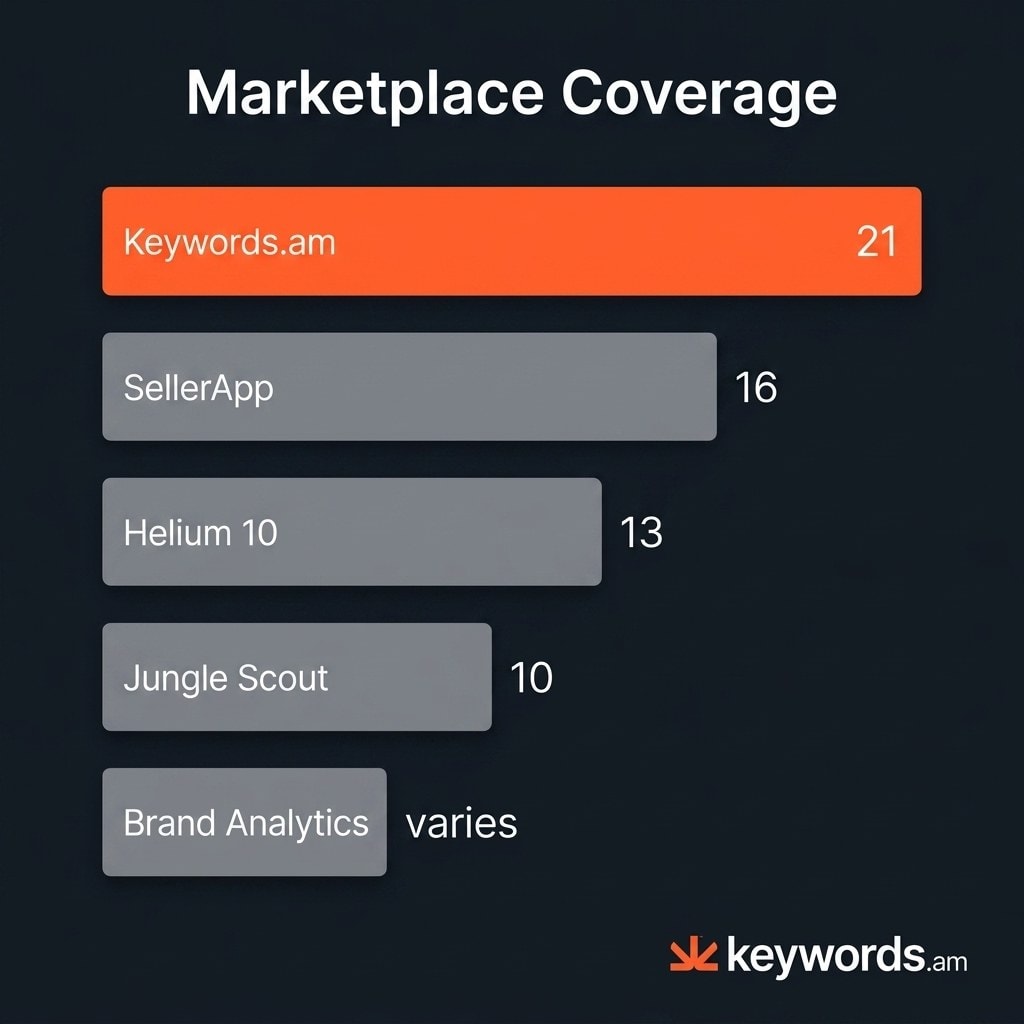
Sellers expanding globally require specialized international expansion tools. The marketplace count differential speaks for itself. The core advantage of Keywords.am lies in intent-aware localization. This workflow step occurs after the initial amazon international keyword research phase. The platform clones a listing into a new marketplace using adapted keyword intent rather than literal translation. Sellers can test this workflow using the Free Amazon keyword tool.
Amazon Brand Analytics offers Search Query Performance data for brand-registered sellers. It displays search frequency rank rather than raw search volume. It functions well as a supplementary data source for active sellers, but it lacks the discovery features needed for cold market entry. Google Trends provides free insights into regional interest over time. It lacks Amazon-specific search data, making it useful for broad market validation rather than precise listing optimization. Helium 10 offers solid support across 13 marketplaces, but falls short of full global coverage.
What are the most common international keyword research mistakes?
The biggest mistakes are relying on Google Translate for keyword lists, ignoring marketplace-specific backend field rules, and launching in all marketplaces simultaneously instead of prioritizing by keyword opportunity.
Using machine translation for keyword lists destroys search intent. It strips away local idiom and compound word structures. Translating “wireless earbuds” directly into German often misses the dominant local search term entirely, leaving the listing invisible to actual buyers. Sellers must rely on a dedicated Amazon keyword research methodology adapted for regional dialects. Translation without validation is a fast track to zero impressions.
Assuming a US bestseller will automatically dominate Europe ignores shifting product-market fit. A product ranking number one in the US might face entrenched local competitors in Germany or strict regulatory barriers in Japan. The search volume might exist, but the conversion rate will plummet if the product does not match local expectations.
Ignoring marketplace-specific backend keyword rules restricts product visibility. According to Amazon Seller Central’s keyword guidelines, Japan permits 500 bytes for backend keywords. The US allows only 249 bytes. Sellers copying a US listing directly to Japan leave 251 bytes of indexing opportunity empty. Each marketplace algorithm also weights title keywords, backend keywords, and bullet points differently. Failing to adapt to these structural rules cripples a product’s ranking potential.
Launching in all marketplaces at once drains capital and focus. It forces sellers to spread their resources thin across unproven regions. Sellers should prioritize two or three marketplaces showing the strongest keyword opportunity. Validate those regions, refine the process, and then expand further. Proper product niche validation dictates a measured, data-driven rollout.
Frequently Asked Questions About Amazon International Keyword Research
These are the most common questions sellers ask about researching Amazon keywords across international marketplaces.
What is the best tool for international Amazon keyword research?
Keywords.am supports 21 Amazon marketplaces with reverse ASIN lookup, search volume data, and TFSD listing optimization per marketplace. This provides more international coverage than any other Amazon keyword tool. Helium 10 covers 13 marketplaces, and Jungle Scout covers 10.
How do sellers research keywords in a language they don’t speak?
Start with reverse ASIN on local competitors. Their keywords are already validated by marketplace performance. Tools like Keywords.am surface these keywords with search volume data regardless of language. Then validate with a native speaker or localization service before publishing.
Which Amazon marketplace should sellers expand to first?
Amazon UK is the most common first expansion for US sellers because English eliminates the language barrier. After the UK, Germany (Amazon.de) is the largest European marketplace by revenue. Japan (Amazon.co.jp) offers high margins but requires more localization investment.
Do sellers need separate keyword research for each marketplace?
Yes. Each Amazon marketplace has different search behavior, keyword competition levels, and character or byte limits. Keywords that rank in the US may not even be searched in Germany or Japan. Independent research per marketplace is required.
How different are keywords between Amazon US and Amazon UK?
They are significantly different for many product categories. British English uses distinct terminology like “nappy” instead of “diaper,” “hob” instead of “stovetop,” and “trainers” instead of “sneakers.” Measurement units also differ. Sellers should research UK-specific keywords rather than copying US listings.
Conclusion
- Translation is not keyword research. Every marketplace needs its own dedicated keyword strategy based on local search volume and cultural intent.
- The 5-step method works globally. Identifying categories, sourcing native seeds, checking local volume, validating intent, and mapping to TFSD fields ensures success across all 21 Amazon marketplaces.
- Unique linguistic structures demand attention. Germany’s compound words, Japan’s multi-script search behavior, and the UK’s regional terminology require localized approaches.
- Keywords.am offers unparalleled coverage. It is the only tool supporting 21 marketplaces with reverse ASIN, search volume, and TFSD optimization in a single workspace.
Try a reverse ASIN lookup on a local competitor in the target marketplace today. Analyze their keywords to see the gap between translation and true amazon international keyword research. Stop guessing with translated search terms and start targeting the keywords driving actual sales volume.
Research keywords in any of 21 Amazon marketplaces using the free Amazon keyword tool.