Amazon Fundamentals
The best Amazon pricing strategy starts with keyword data (not just costs)
Amazon pricing strategy should start with keyword demand data, not just costs. Learn 5 pricing frameworks and how search volume trends inform smarter price decisions.

Amazon’s algorithm makes roughly 2.5 million price changes every day. Most sellers respond by watching competitors and adjusting accordingly. But they’re missing the biggest variable in their pricing equation: keyword demand data.
Every Amazon pricing strategy guide on the market focuses on costs and competition. None connect search demand data (search volume, keyword competitiveness, seasonal trends) to real-world pricing decisions.
This article covers the five core pricing strategies, then shows how keyword demand data changes which strategy to deploy, when to adjust prices, and how listing optimization supports higher price points long-term.
What are the 5 core Amazon pricing strategies sellers should know?
The five core Amazon pricing strategies are competitive pricing, value-based pricing, penetration pricing, price skimming, and dynamic pricing, each suited to different product stages and market conditions.
Competitive pricing involves matching or slightly undercutting competitor rates. This approach works for commoditized products where buyers show extreme price sensitivity and minimal brand loyalty. The primary risk? An uncontrollable race to the bottom that destroys margins across the entire category. Winning the Amazon Buy Box through competitive pricing requires balancing tight margins with fulfillment metrics.
Value-based pricing sets the price tag based on perceived customer value rather than landed costs. Brand registry sellers rely on this approach to capture premium margins on differentiated products. A successful value-based approach demands strong product presentation and market trust.
Penetration pricing deploys an intentionally low initial price to gain market share and accumulate verified reviews. This tactic helps fresh product launches break through saturated markets. Sellers should deploy this carefully. Sustained low prices can train customers to expect discounts, making future price increases difficult.
Price skimming introduces a product at a high initial price that decreases over time. Innovative or exclusive products benefit most from this method before imitators enter the space. The high initial tag captures revenue from early adopters willing to pay for immediate access.
Dynamic pricing uses algorithmic adjustments based on active demand, competition, and inventory levels. Amazon itself relies on this model to process millions of updates daily.
| Strategy | Best For | Risk | When to Use |
|---|---|---|---|
| Competitive Pricing | Commoditized goods | Race to the bottom, margin loss | Mature markets with clear price expectations |
| Value-Based Pricing | Differentiated brands | Failure to convert price-sensitive buyers | Strong brand presence and high listing quality |
| Penetration Pricing | New product launches | Trapping the brand in a low-price tier | Initial launch phase to drive review velocity |
| Price Skimming | Innovative products | Imitators undercutting the floor | Early product lifecycle before saturation |
| Dynamic Pricing | Large catalogs | Algorithmic mismanagement | High-volume sales demanding quick responses |
These five strategies give sellers a framework. But which one to choose depends on a variable most pricing guides ignore entirely.
How does keyword demand data change Amazon pricing decisions?
Keyword demand data reveals whether a product sits in a saturated or niche market, directly informing whether aggressive or premium pricing will perform better.
High search volume combined with extreme keyword competition points to a saturated market. Sellers in these dense environments face relentless pricing pressure. They typically need aggressive, competitive pricing just to win organic visibility on the first page. High competition means dozens of sellers fighting for the same pool of buyers, compressing margins across the board.
Low search volume paired with low keyword competition indicates a niche market where premium pricing remains sustainable. Fewer competitors give sellers true pricing power. Buyers searching for specific, specialized solutions have few alternatives. A thorough Amazon competitor analysis often uncovers these profitable micro-niches hidden beneath broader, crowded parent categories.
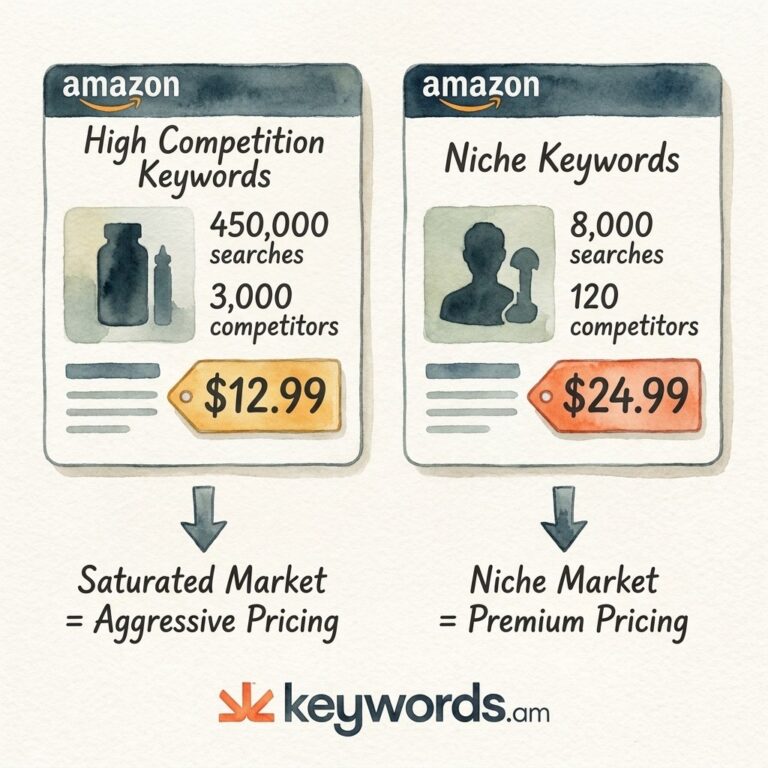
Consider two hypothetical garlic presses in the same kitchen subcategory. Product A targets the short-tail keyword “garlic press,” which receives roughly 450,000 monthly searches but faces over 3,000 competing listings. This seller needs aggressive competitive pricing at $12.99 to generate any sales velocity. Product B targets the long-tail keyword “stainless steel garlic rocker,” which captures 8,000 monthly searches but faces only 120 competing listings. Product B sustains premium pricing at $24.99 because specialized demand outpaces limited supply.
Brand Analytics Search Query Performance data validates this concept. The report details conversion share by query. Sellers with strong pricing power show dominant conversion rates on specific long-tail search terms rather than broad, competitive ones.
Knowing demand is one thing. Having a structured framework to turn that data into a concrete pricing decision is another.
What is the TFSD pricing framework and how does it inform Amazon pricing?
The TFSD framework analyzes Traffic, Frequency, Spend, and Demand for a product’s keyword landscape, revealing whether to compete on price or differentiate on value.
Traffic represents total search volume across all relevant keywords for a product. Categories with massive traffic volumes generally require competitive pricing to capture and retain market share against established incumbents.
Frequency measures how often buyers search for specific terms over a sustained period. High frequency indicates consistent, recurring demand where stable pricing models thrive. Sellers use the TFSD framework to map these metrics before making any major pricing adjustments.
Spend analyzes pay-per-click cost data to reveal what competitors pay for visibility. High CPC categories signal that aggressive pricing wars eat into already-thin margins. A controlled Amazon PPC keyword strategy helps offset rising acquisition costs by targeting cheaper, long-tail terms.
Demand tracks the trend direction over trailing months. Rising demand supports holding firm on pricing or pushing calculated increases. Declining demand signals the right time to introduce targeted penetration discounts.
Picture a seller conducting a TFSD audit on their catalog. They discover their primary keyword landscape holds moderate traffic but features low competition and a rising demand trend over six months. The data supports premium positioning rather than a price war. Keywords.am provides this level of demand intelligence. The Explore plan is free, and the Seller plan starts at $49 per month ($39 billed annually).
TFSD maps the current keyword landscape. But demand isn’t static. Seasonal shifts create pricing windows that most sellers miss entirely.
How do seasonal keyword trends signal when to change Amazon prices?
Seasonal keyword trends act as leading demand indicators - rising search volume signals hold-firm pricing, while declining volume signals penetration pricing windows.
Search volume works as a leading indicator for consumer intent. When search volume for “mosquito repellent” spikes in early May, sellers receive a clear signal to hold firm on pricing. Demand outpaces supply in that moment. When that same volume drops in November, penetration pricing becomes necessary to maintain baseline sales velocity.
Sellers who adjust pricing based on keyword trend signals operate two to four weeks ahead of competitors who wait for actual sales data to shift. Waiting for a sales dip means reacting to a market that has already moved. An Amazon seasonal keyword strategy enables action before the shift occurs. Sales data is a lagging indicator; keyword search volume predicts what’s coming.
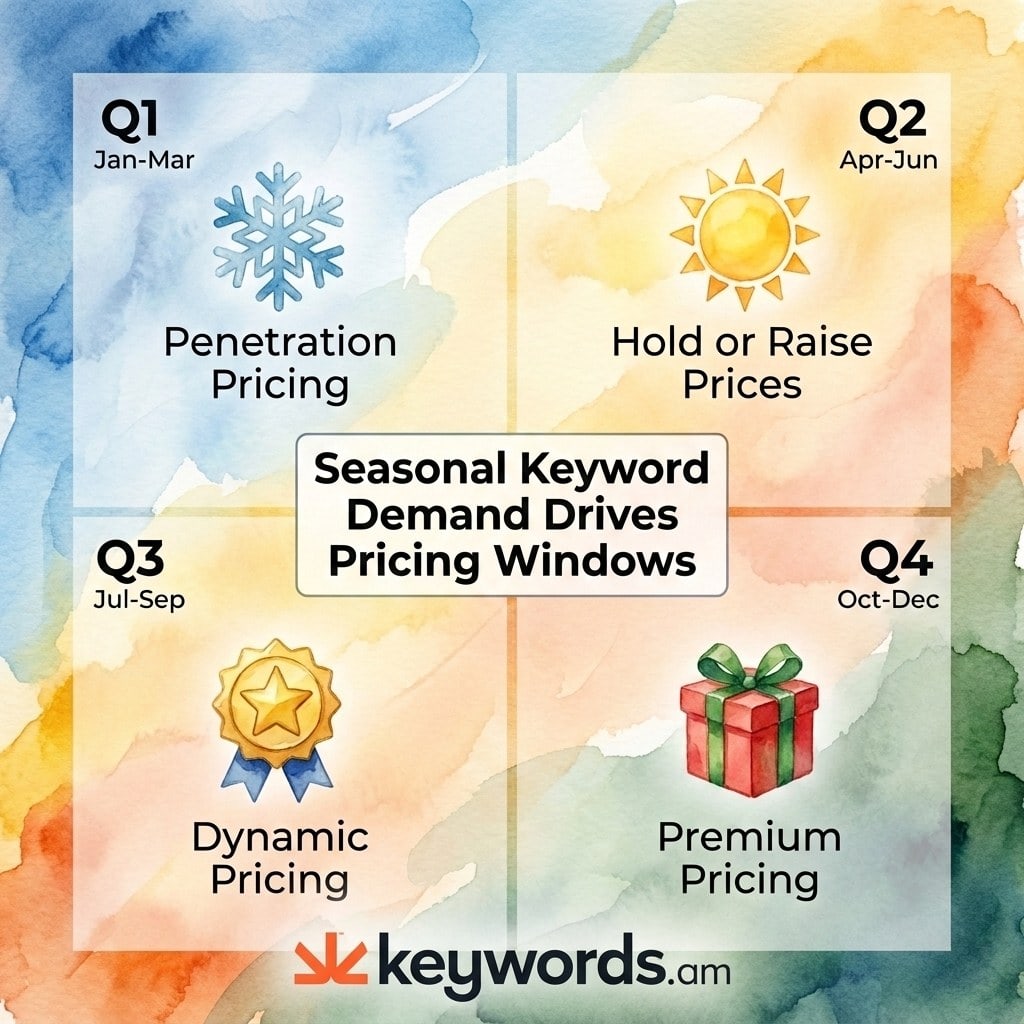
4-Season Amazon Pricing Strategy Calendar
| Quarter | Timeline | Core Strategy | Trigger Condition |
|---|---|---|---|
| Q1 | Jan–Mar | Penetration Pricing | Post-holiday demand dip requires lower prices for lagging SKUs. Competitive pricing for evergreen goods. |
| Q2 | Apr–Jun | Hold/Raise Prices | Spring demand surge activates. Hold or raise prices where seasonal keyword volume rises. |
| Q3 | Jul–Sep | Dynamic Pricing | Prime Day and back-to-school categories create volatility where algorithmic pricing thrives. |
| Q4 | Oct–Dec | Premium Pricing | Peak holiday demand creates scarcity. Premium pricing sustainable for gift categories. |
Seasonal trends tell sellers when to adjust. But there’s another factor that determines how much pricing power a seller actually holds.
Why do better-optimized Amazon listings command higher prices?
Better-optimized listings convert at higher rates, which directly supports higher price points because Amazon’s algorithm rewards conversion velocity over low prices.
Conversion rate is the hidden variable in price elasticity. A poorly optimized listing might convert at 8% when priced at $19.99. A well-optimized listing can convert at 15% when priced at $24.99. The optimized listing generates more revenue per impression despite the higher price tag.
Improving a baseline Amazon conversion rate grants a brand real pricing flexibility. Strategic keyword coverage in titles, bullet points, and backend search terms increases organic visibility. This drives high-intent traffic at zero marginal cost. A higher retail price at the same FBA fee tier improves profit margins, and sellers can verify this using an Amazon FBA calculator.
A+ Content and brand storytelling justify premium positioning to the consumer. Buyers pay more when they trust the brand presentation and perceive superior quality.
Products that maintain sales velocity through better conversion rates sustain stronger organic positions. A solid Amazon BSR builds a compounding advantage: high visibility feeds high conversions, cementing a product’s premium price point in the marketplace.
Higher prices work, as long as they stay within Amazon’s guardrails.
What are Amazon’s pricing policies and fair pricing guardrails?
Amazon enforces fair pricing policies that flag products priced significantly above recent market rates, and violations can result in listing suppression or Buy Box removal.
Amazon monitors the marketplace for prices set significantly higher than recent averages offered on or off the platform. The Fair Pricing Policy protects customers from price gouging. Violations trigger price alerts and can lead to listing suppression until the seller corrects the price.
Brands with Minimum Advertised Price (MAP) policies need to ensure all authorized sellers comply. Amazon does not enforce MAP agreements on behalf of brands. Brand owners must police unauthorized discounting themselves using external tracking tools.
Referral fees vary by category and directly affect the pricing floor. The Electronics category charges a relatively low 8% referral fee, while Jewelry commands a steep 20% fee. Amazon Apparel sits at 17%, and Health & Personal Care at 8–15% depending on price tier. An Amazon FBA calculator helps determine exact profitability limits before finalizing any amazon pricing strategy.
Pricing too far above competitive levels removes Buy Box eligibility. The strategic sweet spot balances target margins with Buy Box retention limits.
These are the most common questions sellers ask about Amazon pricing strategy.
Frequently Asked Questions About Amazon Pricing Strategy
What is the best pricing strategy for new Amazon products?
Penetration pricing works best for new Amazon products. Set a lower initial price to drive early sales velocity, reviews, and keyword ranking, then gradually increase once organic position is established. Apply the TFSD framework to validate whether low pricing fits the specific keyword landscape.
How often should I change my Amazon prices?
Most sellers should review prices weekly and adjust based on competitor moves, seasonal demand shifts, and keyword trend changes rather than on a fixed schedule. Seasonal keyword trends provide the best timing signals for when adjustments make the most impact.
Does pricing affect Amazon search ranking?
Amazon’s A10 algorithm does not rank by price directly, but pricing affects conversion rate and sales velocity, which are primary ranking signals. Better conversion rates drive stronger rankings regardless of the specific price tag.
What is Amazon’s fair pricing policy?
Amazon’s fair pricing policy flags products priced significantly higher than recent market rates. Violations can trigger listing suppression, Buy Box removal, or account warnings. Even temporary price spikes during low-stock periods can trigger automated alerts.
How do I avoid a race to the bottom on Amazon?
Sellers avoid price wars by targeting niche keyword segments with less competition, differentiating through listing quality and A+ Content, and using value-based rather than competitive pricing. Niche keyword demand grants natural pricing power that commodity keywords don’t.
What is dynamic pricing on Amazon?
Dynamic pricing uses algorithmic adjustments to change prices based on competitor activity, demand levels, time of day, and inventory levels. Amazon itself processes roughly 2.5 million automated price changes daily across its catalog.